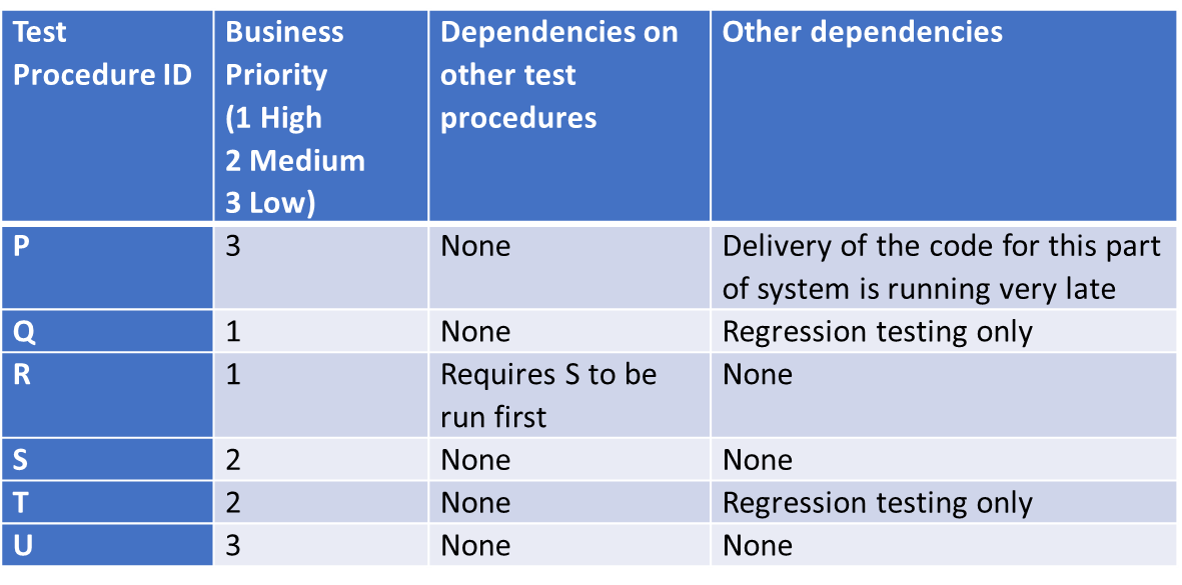
1. Business Priority: The tests with higher business priority (1) should be executed first, followed by those with lower priority.
2. Dependencies: Tests that are dependent on others must be scheduled accordingly. For example, R requires S to be run first.
3. Regression Testing: Regression tests (Q and T) should only be run after all other tests have completed.
Sequence Justification:
· S (Priority 2, No dependencies): Can be run first.
· R (Priority 1, Requires S): Must follow S due to its dependency.
· U (Priority 3, No dependencies): Can be run after S and R since it has no dependencies.
· P (Priority 3, No dependencies, but code delivery is late): Can be run after S, R, and U.
· Q (Priority 1, Regression testing only): Should be run after all other tests except T due to its regression testing requirement.
· T (Priority 2, Regression testing only): Should be run last as it's also a regression test.
Why Other Options Are Incorrect:
A. S, R, P, U, Q, T: This option runs P before Q and T, but P has a lower priority and should be run later due to the late code delivery.
B. Q, R, S, T, P, U: Runs Q first, which is incorrect as Q is a regression test and should be run after all other tests.
C. R, Q, S, T, U, P: Starts with R, which is fine for priority, but runs Q second, which is a regression test and should be at the end.
Example:
· Running a high-priority test first ensures critical functions are validated early.
· Running dependent tests in order (e.g., S before R) ensures dependencies are met.
· Regression tests (Q and T) should be at the end to confirm no issues arise from previous tests.